Chicago winters are not kind to metal. Freeze-thaw cycles, road salt drift, and lake-effect moisture put fencing materials through conditions that homeowners in milder climates simply never deal with. Pick the wrong material and you’re looking at rust streaks on your foundation, sagging gates, and repair bills within a few years. Pick the right one and a fence can last decades without much fuss.
For most Chicago property owners, the decision eventually narrows to two options: wrought iron or aluminum. Both have a similar aesthetic profile. Both work well for residential and commercial properties. But they behave very differently over time, and the right choice depends heavily on what you’re fencing, where it sits, and how much ongoing maintenance you’re prepared to handle.
This breakdown covers what actually matters before you commit.
What You’re Actually Comparing
At first glance, wrought iron and aluminum fencing can look nearly identical. Both offer classic vertical picket styles, ornamental scrollwork, and that sharp, finished look common across Chicago’s older neighborhoods like Lincoln Park, Gold Coast, and Old Town. The difference is in the material itself, and that difference drives everything from installation cost to long-term performance.
Wrought iron is dense, heavy, and exceptionally strong. It’s a low-carbon iron alloy that has been used in architectural fencing for centuries. When properly fabricated and finished, it’s one of the most durable fencing materials available. The tradeoff is weight and a real vulnerability to rust if the protective coating is compromised.
Aluminum is a lightweight, non-ferrous metal, which means it does not rust. Modern aluminum fencing is pressure-cast or extruded, powder-coated, and generally low maintenance. It’s lighter than wrought iron, easier to install, and costs less upfront. It is, however, softer. Under significant impact or stress, aluminum can bend or crack in ways that wrought iron typically won’t.
Understanding that core distinction sets the stage for everything else.
Durability and Structural Strength
If sheer physical toughness matters to you, wrought iron wins. It’s substantially heavier and more rigid, which is why it remains the material of choice for security-grade fencing, heavy gates, fire escape railings, and any application where structural integrity is non-negotiable.
For a commercial property in Wrigleyville managing high foot traffic and the occasional accidental impact, the added density of wrought iron is a genuine asset. A delivery truck clips a corner of an aluminum fence and you’re likely looking at a bent or cracked section. The same impact on a properly anchored wrought iron fence may leave a surface scratch and nothing more.
That said, aluminum performs well for most residential applications. A front yard fence in a quieter neighborhood, a garden boundary, or decorative fencing around a patio doesn’t need the load-bearing strength of wrought iron. For those contexts, aluminum is more than adequate.
The bigger issue for Chicago specifically is how each material handles ground movement. Frost heave, caused by repeated soil freezing and thawing, can shift fence posts over time. Heavier wrought iron posts, when properly set in concrete footings below the frost line (typically 48 inches in northern Illinois), resist this movement better. Aluminum posts, lighter and with less mass, can be more susceptible to gradual shifting if installation isn’t done carefully.
Rust, Corrosion, and Long-Term Maintenance
This is where the two materials diverge most sharply.
Aluminum doesn’t rust. Period. Its natural oxide layer forms a barrier against corrosion, and when a powder-coated finish is added during manufacturing, the protection is excellent across decades. For a property owner who doesn’t want to think about annual painting or spot-treating rust, aluminum is the more hands-off option.
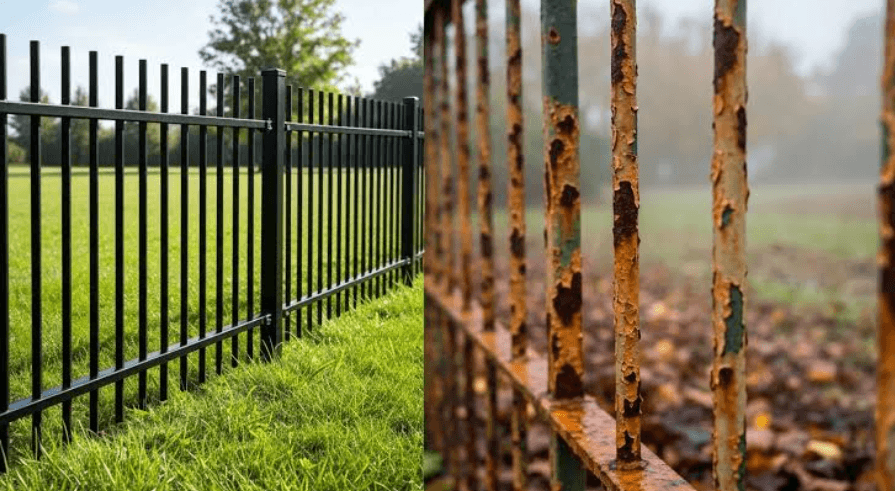
Wrought iron, despite its strength, does rust when the protective coating breaks down. Small chips, scratches, or worn spots in the paint allow moisture and oxygen to reach the iron beneath. Left untreated, surface rust spreads. In Chicago’s climate, that process can accelerate quickly.
The solution isn’t to avoid wrought iron. It’s to maintain it properly. A properly painted wrought iron fence, touched up as needed and given a full repaint every five to seven years, can look sharp and remain structurally sound for generations. Many of the decorative iron fences still standing in Chicago’s historic neighborhoods are well over 50 years old. They’ve lasted because of consistent upkeep, not because rust is impossible.
The maintenance burden is real, though. If a property owner isn’t prepared to stay on top of it, or isn’t working with a contractor who can handle periodic painting and rust treatment, aluminum becomes a more practical choice.
Aesthetic Considerations for Chicago Architecture
Chicago’s housing stock skews older. Victorian-era greystones, two-flats from the early 1900s, and brick bungalows from the 1920s and 30s all have architectural personalities that benefit from fencing that fits the period.
Wrought iron carries a visual weight and warmth that aluminum can approximate but doesn’t quite replicate. The density of the material, especially in custom-fabricated pieces with ornamental details, reads as historically authentic in a way that matters for properties where curb appeal and neighborhood character are priorities. For landmark buildings or historic preservation zones, this can even be a practical requirement rather than just a preference.
Aluminum has made significant aesthetic strides over the past two decades. Modern aluminum fencing comes in a wide range of styles, powder-coat colors, and finishes. For contemporary builds or newer commercial developments, aluminum often blends in seamlessly and at lower cost.
For homeowners in older Chicago neighborhoods trying to match existing ironwork or maintain a consistent look with adjacent properties, custom wrought iron is typically the better fit. The team at Americana Iron Works & Fence has worked on properties across Chicago for over 30 years, which means they’ve seen nearly every architectural style the city offers and understand what fits where.
Cost: Upfront vs. Lifetime
Aluminum fencing generally costs less to purchase and install. The material is lighter, easier to transport, quicker to install, and doesn’t require the same fabrication time as custom wrought iron. For a large-scale perimeter fence on a commercial property, that difference in upfront cost can be substantial.
Wrought iron carries higher initial costs. Custom fabrication, the weight of the material, and more involved installation all add to the price. But the calculus changes when you factor in longevity. A well-maintained wrought iron fence isn’t something you replace. Aluminum, while durable, doesn’t carry the same multi-generational lifespan expectation.
There’s also a property value consideration. According to data from the American Society of Landscape Architects, quality fencing consistently ranks among the exterior improvements that return the most value on residential properties. Ornamental wrought iron, particularly in historically relevant urban neighborhoods, can add meaningful curb appeal and buyer confidence.
The practical question for most property owners isn’t which material is cheaper. It’s which delivers better value over the ownership period. For a short-term rental property or a newer suburban home, aluminum may win that equation. For a classic Chicago brownstone that’s going to stay in the family, wrought iron usually makes more sense.
Gate and Security Applications
Gates deserve separate consideration because the functional demands are higher than standard fencing sections.
For a driveway gate, pedestrian entry gate, or any gate that’s going to open and close regularly under load, wrought iron is typically the stronger choice. The hinges carry more stress than on a fixed fence panel, and the structural mass of wrought iron holds up better to that repeated movement over years.
Heavy aluminum gates exist and perform adequately for lighter residential applications. But for a commercial property managing vehicle access or a building entrance that sees constant daily use, wrought iron fabricated to spec is the more reliable long-term investment.
Gate automation adds another layer. Automatic openers put additional mechanical stress on gate frames and hinges. Wrought iron’s rigidity makes it a better host for motorized systems than lighter aluminum alternatives.
Making the Right Call for Your Specific Property
There’s no universal right answer between wrought iron and aluminum. The better choice depends on a clear-eyed look at a few factors:
- Structural demands: Security perimeters, heavy gates, fire escapes, and commercial applications generally favor wrought iron.
- Maintenance commitment: If ongoing upkeep isn’t realistic, aluminum’s corrosion resistance is a real practical advantage.
- Architectural context: Older Chicago homes and historic neighborhoods tend to suit wrought iron’s visual and aesthetic weight.
- Budget timeline: Aluminum costs less upfront; wrought iron often costs less over a full ownership period.
- Custom requirements: For non-standard dimensions, ornamental designs, or matching existing ironwork, in-house fabrication with wrought iron offers precision that off-the-shelf aluminum panels can’t match.
For properties with existing iron fencing that needs repair or partial replacement, the Americana iron fence service page covers both new installation and restoration work, which is worth reviewing if you’re dealing with aging sections that need to be matched rather than replaced entirely.
Key Takeaways
- Wrought iron offers superior structural strength, better resistance to impact, and a more historically authentic aesthetic suited to Chicago’s older building stock.
- Aluminum is lighter, naturally corrosion-resistant, and lower maintenance, making it a practical choice for residential applications where heavy-duty performance isn’t required.
- Chicago’s climate demands proper installation depth for all metal fencing, with posts set below the 48-inch frost line to resist seasonal heaving.
- Wrought iron requires consistent maintenance, particularly paint touch-ups and rust treatment, but a well-maintained iron fence can outlast aluminum by decades.
- Gate applications, especially motorized or high-use gates, favor wrought iron for its rigidity and load-bearing capacity.
Frequently Asked Questions
How long does wrought iron fencing last compared to aluminum? A properly maintained wrought iron fence can last 50 years or more. Many examples in Chicago’s older neighborhoods have been standing for generations. Aluminum, with its powder-coat finish intact, typically carries a 20 to 30-year lifespan before the finish may need attention or sections require replacement.
Does aluminum fencing look as good as wrought iron? Modern aluminum fencing is visually competitive for most residential and commercial settings. However, custom wrought iron has a density, warmth, and detail that aluminum approximates rather than matches exactly. For historic properties or homes with existing ornamental ironwork, wrought iron usually provides a more authentic visual result.
Can wrought iron fencing be repaired, or does it need full replacement? Wrought iron is highly repairable. Individual sections, pickets, and decorative elements can be fabricated to match existing pieces and welded in place. This is one of wrought iron’s practical advantages: you’re rarely forced into a full replacement just because one section is damaged or rusted.
Which option is better for a Chicago commercial property? For most commercial applications, especially those involving security, vehicle access, or high-traffic pedestrian entry, wrought iron is generally the better fit. Its structural mass, repairability, and strength under load make it more appropriate than aluminum for demanding commercial contexts.
How does Chicago weather affect the choice between the two materials? Chicago’s freeze-thaw cycles and lake moisture create real maintenance demands for wrought iron, as any breach in the paint layer accelerates rust. Aluminum avoids that specific issue entirely. However, both materials perform well in Chicago’s climate when properly installed and, in the case of wrought iron, properly maintained. Climate is a factor in ongoing upkeep, not a reason to rule out either material entirely.
See also: Advertise a Business to Build Visibility and Long-Term Growth
Conclusion
The wrought iron vs. aluminum decision doesn’t need to be complicated. Get clear on what the fence actually needs to do, how much ongoing maintenance is realistic, and what the property’s architectural context calls for. Those three factors will point toward an answer faster than any general comparison ever could.
Both materials have real merit. Both are widely used across Chicago’s residential and commercial properties. The difference is in the specifics, and specifics are exactly what most buyers don’t think through carefully enough before signing a contract.
If you’re working through this decision for a Chicago property, getting a professional assessment of your site conditions, existing ironwork, and long-term goals is the most practical next step before committing to either option.